

Fr Christopher Foeckler, MJ • St Josaphat Formation Center • Phoenix, AZ
There are three kinds of basic Christian prayer: vocal prayer, in which we repeat wonderful words authored by the Church, Saints and even by our Savior Himself; then there is meditative or mental prayer where we hold conversation with “the One by whom we know we are loved” about ideas we have considered reflectively and speak to Him with words that come from our own mind and heart moved by His grace; and finally, there is contemplation where the words tend to cease, and an unspoken kind of converse between God and ourselves happens in the form of a child-like gaze on some aspect of the Creator or His creation which quiets and gives rest and renewed strength to the soul. For anyone who is faithful to seeking God in prayer there will be a steady progression from vocal to mental prayer and then onto contemplation. Faithfulness to prayer is the most important ingredient of all to experience the benefits of contemplation, and be disposed for the Holy Spirit to lead one on to greater union with God.
The Holy Rosary should employ all three levels of prayer. “By its nature,” Pope Paul VI wrote, “the recitation of the Rosary calls for a quiet rhythm and a lingering pace, helping the individual to meditate on the mysteries of the Lord’s life as seen through the eyes of her who was closest to the Lord. In this way the unfathomable riches of these mysteries are disclosed.” Frequent recitation of the Rosary in this way leads inevitably to the higher form of prayer in contemplation.
“The most important reason for strongly encouraging the practice of the Rosary,” writes St. John Paul, “is that it represents a most effective means of fostering among the faithful that ‘commitment to the contemplation of the Christian mystery’ which I have proposed in the Apostolic Letter Novo Millennio Ineunte as a genuine ‘training in holiness.’”
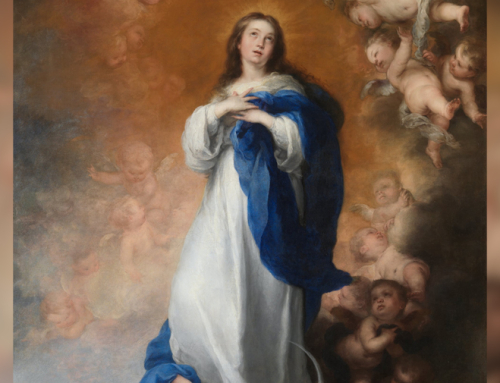
This “training in holiness” is acquired by frequent repetition of the Rosary with Mary. As St. John Paul says, “Mary constantly sets before the faithful the ‘mysteries of her Son,’ with the desire that the contemplation of those mysteries will release all their saving power. In the recitation of the Rosary, the Christian community enters into contact with the memories and the contemplative gaze of Mary.”
This post is also available in:
 Hindi
Hindi  Italian
  Polish
  Slovak
  Spanish
  Ukrainian