
When asked which was the greatest commandment, Our Lord immediately enunciated the precept of charity, to love God above all and one’s neighbor as one’s self. Perfection in charity is, without question, the primary precept and common goal of the followers of Christ.
 Jesus clearly distinguished between command and counsel, between end and means. The safer and more direct way of observing the primary precept and attaining the desired end of Christian life is by means of the counsels: voluntary virginity, poverty of spirit and obedience to the will of God and the Christian community. His counsel to the rich young man was in response to the question of the average Christian, “What is yet wanting to me?” To be a eunuch for the sake of the kingdom of God is not for all, but “let him accept it who can.”
Yet from the beginning of the Church the early Christians strove to fulfill counsel as well as command, or better still, to observe the counsels in order to obey the commandments. The primitive Christian community was the prototype of the contemporary Christian community. Especially was this true with regard to communal life and the required sacrifice of individual possessions. In the primary source of early Church history (Acts of the Apostles 5: 32-35) we read about the manner of life of these early Christians: “Now the multitude of the believers were of one heart and one soul, and not one of them said that anything he possessed was his own, but they had all things in common. And with great power the apostles gave testimony to the resurrection of Jesus Christ our Lord. Nor was anyone of them in want. For those who owned land or houses would sell them and bring the price of what they sold and lay it at the feet of the apostles, and distribution was made to each according to their need.”
This arrangement was feasible with a small group of Christian believers living together in community. Later, however, with the spread of Christianity throughout the known world, such universal communal life was impractical. …Out of these primitive Christian communities came the heroic martyrs who dared to defy the pre-eminence of paganism and wrote their testimony of faith in blood, the physical sacrifice of their lives as witnesses to the revelation of Christ. Only after Constantine and the Edict of Milan in the fourth century did these martyrdoms cease, save for the few months of the reign of Julian the Apostate.
Then the new Christian era began, a period which brought new problems to the faithful: heresy, Church-state conflict, the remnants of pagan immorality, the inevitable smoldering of the zeal fired by the immediate Apostles and disciples of Christ. As an antidote to this spiritual sickness a new movement came into the Church. It began in the East where these problems were very pronounced. The great exodus of Christians into the desert renewed and refreshed the ideal of Christian Perfection.
Consider just how revolutionary this movement was! Frank Sheed, in his introduction to his edition of Helen Waddell’s ‘The Desert Fathers’ (pp. 18-19) describes this situation very well:
“There were no monks or nuns as we know them now. The priesthood was not yet a distinct profession. The priest might be a married man with a family, he dressed like everyone else, and it was normal to earn his living by the practice of any trade or profession he had skill in. What we now take for granted as the religious life had made only small beginnings. Numbers – very considerable numbers it seems – of men and women who had undertaken the celibate life and their prestige in the Christian body was second only to the martyrs whose example had been the great preservative of the Christian morale. These continentes did not at first live in communities but in their own homes. They fasted more than other Christians (all Christians fasted and prayed more than we do), they spent long hours in prayer. They lived quietly, dressed quietly, and gave themselves little or not at all to amusement. The works of charity were more and more entrusted to the continentes. From time to time groups of women vowed to continence would set up house together in a first beginning of the conventual life”.
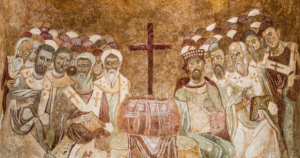 St. Antony was the key figure of this movement into the desert, the first known and prominent hermit who sought the cultivation of Christian perfection in solitude. . . Others rushed to follow his example of asceticism. By 325, the time of the Council of Nicea, there were over 5,000 solitaries, women as well as men, in the Desert of Nitria. They were hermits, living alone and coming together only for the celebration of Mass.
Another kind of religious life, more the kind we know today, arose at about the same time. St. Pachomius founded the first monasteries, communities of men living under a common rule of life to achieve their mutual goal, perfection in Christian charity. They were called Cenobites. The first of these monasteries was located in Tabenna in Egypt. For centuries thereafter the monastic life meant being a hermit or cenobite.
St. Basil, who travelled up the Nile in the middle of the fourth century, recognized and reported the weaknesses of the monastic life he observed. The cenobitic system of Pachomius, he said, was too complex and impersonal. Tabenna was a town, practically an armed camp, a boisterous and undisciplined community of five thousand ascetics.… Only the orthodox spirituality of some of the monks salvaged a degree of success from this mass movement to embrace a form of religious life. . .
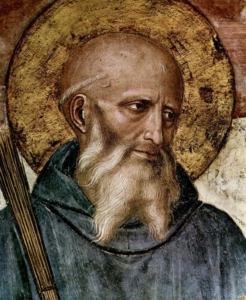 St. Benedict, in the sixth century, formulated a sound rule of religious life which still serves as a conventual rule for many communities today. He shifted the emphasis from physical to spiritual mortification and focused on the end of religious life as distinct from the means of fulfilling it. His motto, Pray and Work, signified a sound and simple approach to Christian perfection. Benedict’s monks, with their quiet simplicity and faithful guardianship of the classical tradition of assiduous study, mental prayer and the dignity of manual labor, were a steadying influence on the Church, so violently rocked by the barbarian invasion.
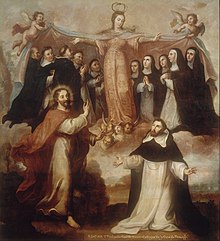
. . . A very significant development occurred in the thirteenth century with the coming of the friars: the establishment of the mendicant orders, particularly the Franciscans and the Dominicans. Religious life assumed new forms and functions. Instead of being confined to the work of worship in single monasteries, the friars moved from one community house to another and engaged in apostolic work outside of their convents. They assumed intellectual leadership in the great universities of Europe. They taught and wrote and preached, the latter function a former prerogative of bishops. They organized democratic government in their houses and left the cloister to spread the faith in mission fields. At the same time, convents of women were founded, and both contemplative nuns and sisters engaged in active work: catechetics, nursing, visiting the poor and giving maternal care to orphans. Religious life began to assume the complexity and variety of structure and function which we know today.
Every order, congregation or society or religious has its particular purpose; each is a different facet in the jewel of dedicated Christian life. Often they were founded to offset and oppose some social evil which was hostile and detrimental to the life of the Church; the Benedictines opposed military might with the power of interior peace; Franciscans fought worldly indulgence with the power of poverty of spirit; Dominicans attacked heresy with the power of knowledge; Jesuits led the counter-offensive after the Reformation with the power of spiritual discipline and enlightened faith.
 In the late 19th century, another significant development occurred when Pope Leo XII took formal steps towards the recognition of associations of laity consecrated to God. In his Decree Ecclesia Catholic, he gave norms for the approval of pious associations whose members remain in the world without wearing any form of habit to identify their consecration to God by way of the counsels.
In 1947, Pope Pius XII fully recognized these associations, approving them as groups known as secular institutes.
Today there are more than 200 Secular Institutes in the world with as many as 60,000 members, all of whom profess vows of poverty, chastity, and obedience without being in a religious congregation.
Soon, other forms of consecrated life would spring up as well, such as Ecclesial Families of Consecrated Life. They are composed of a single charism, constitution, and government, but having two main branches. These branches, one of men (lay and cleric) and one of women, are to some extent self-governing, yet part of a single structure. The members profess the evangelical counsels by public vow or some other type of sacred bond. There are also associated single and married members who share in the charism and goals of the institute; their association is different from the celibate members and they have their own statutes, separate from the constitutions of the institute.
Majority of text taken from Religious Vocation: An Unnecessary Mystery by Fr. Richard Butler, O.P.
